

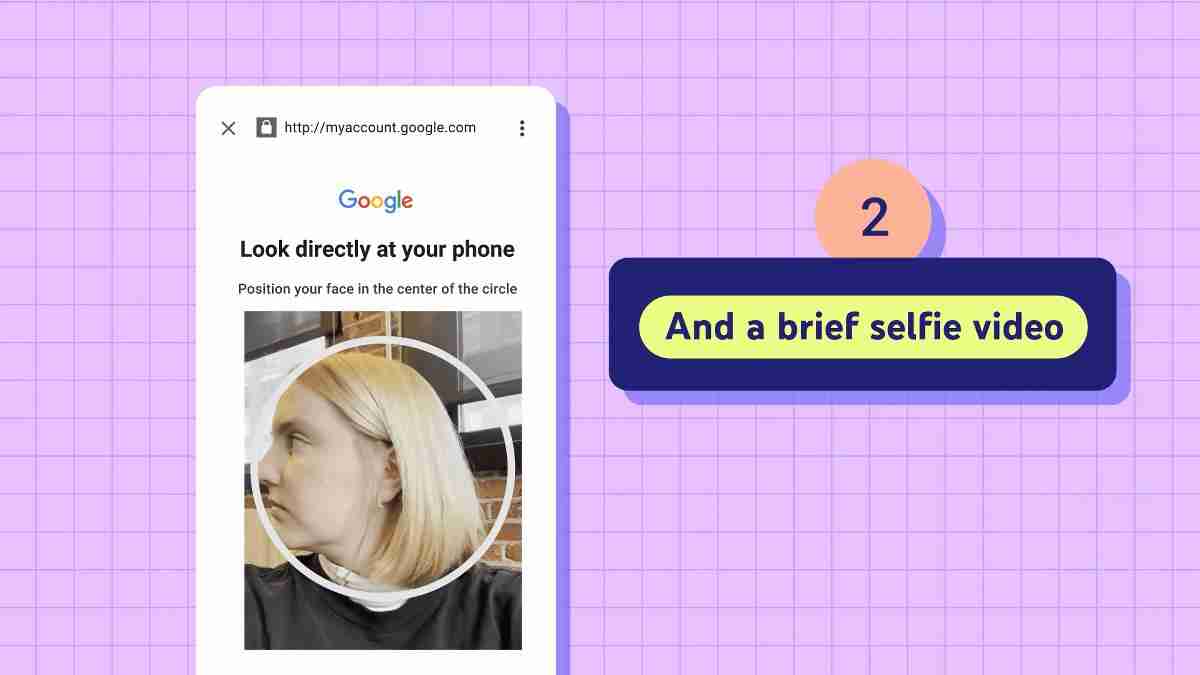
Google has added a new selfie video sign-in choice, which offers a alternative method to recover access to your Google Account without having to rely on the standard recovery options. This has an effective use of facial recognition plus live action detection in a short video of someone’s face to improved assurance identitification by making it harder for impersonators to succeed.
On July 23 Google announced this feature saying that the selfie video is “another alternative for people who find themselves locked out of their accounts or have lost access to their regular phone or computer”. It complements other recovery options like passkeys or recovery contacts.
In order for the feature to be activated, users are prompted to look into their device’s camera and follow a number of guided steps. Google requests users to perform a series of face movements so the system can gather a number of different views of their face. With user approval, this video is saved for use in future identity verifications.
Should the user have difficulty signing in at a later date, Google can request them to take another brief selfie-recording. This new recording can then be scanned against the previous one to assess whether the person trying to re-establish access is the same one who initially installed the feature.
Liveness verification can also be added to the system, which is becoming more commonplace in the modern day, as deepfake videos and AI generated images become very realistic.
Google states they add, which records simple movements, so the system can identify the camera showing a real person and not a still image or malicious recording. Other security systems have been implemented to identify any malicious login attempts. The privacy issue was addressed by Google in the rollout.
Google claims that videos are encrypted in storage and that users have total control over any saved video. Allowed to delete saved video from Google Accountwhich Google says means the selfie can no longer be used for sign-in recovery.
Google also offers a user option to allow the company to use her selfie video and information to improve face-recognition, age-estimation and other capabilities, if to additional improvements.
The permission is distinct from the default sign-in operation this can be useful when losing your phone, or if your password is forgotten or a trusted device cannot be reached. The user may be able to authenticate with their face, relying less on email recovery options, a phone number, or an authentication device. That said, not every Google Account has access to selfie sign-in.
As documentation from Google, currently Workspace, child accounts and accounts participating in the Advanced Protection Program (APP) are unable to add selfie videos. This functionality also seems to differ given location and device. Alternatively, users who wish to see if their account qualifies should visit Google’s dedicated setup page, g.
co/signin-selfie. Instead of exclusively according to selfie authentication Google advises that an account set up was should have various other recovery options open. The launch comes at a time when identity online is ever more complex.
